
Dr. Williams-Sutherland and the Kindness Tree

Updated: 2 days ago

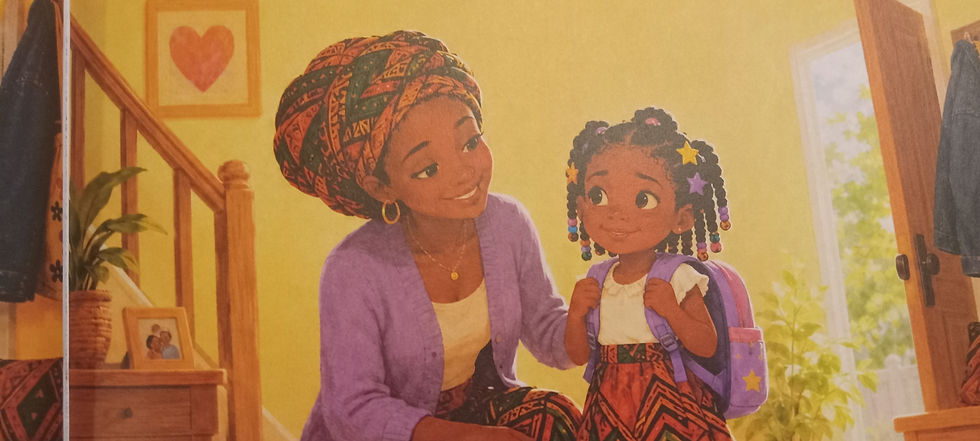
It’s Ngozi’s first day of first grade. She is excited, but also a little scared, because it’s her first year in a new district after her family moved from Harlem, New York, to a leafy Connecticut suburb. Will she like her teacher? (She will.) Will the kids be nice to her? (Most of them will be.) And what in the world is a kindness tree?
Ngozi is the hero of Ngozi and the Kindness Tree, a new children’s book with a powerful message by author Dr. Tania Nicole Williams-Sutherland. Dr. Williams-Sutherland published her book shortly after graduating from UB’s School of Education with a Doctorate in Educational Leadership. Wild Knights caught up with Dr. Williams-Sutherland to talk about Ngozi, cultural responsibility, and Dr. Williams-Sutherland’s own eventful career.
WK: In your “About the Author” note in the back of the book, you say that the story of Ngozi and the Kindness Tree is based partly on personal experiences. Can you describe how your own life inspired you to write this book?
Dr. Williams-Sutherland: Firstly, thank you, Dr. Laist, for giving me a chance to talk about my debut children’s book Ngozi and the Kindness Tree. I am appreciating the support from the University of Bridgeport’s educational department and Phi Kappa Phi, which is how we have crossed paths!
Ngozi and the Kindness Tree is near and dear to my heart for so many reasons. The book is dedicated to my favorite elementary teacher, whose name is Ms. Rita Smith (Roberts Elementary School - a gifted and talented school with a focus on fine arts, in Houston, Texas). Ms. Smith was very kind, caring, and an overall amazing teacher who taught me about the Holocaust and tutored me at my home. It is also dedicated to my son NÍco, and my former students. Serving as a paraprofessional, teacher, instructional coach on Social/Emotional Learning, AP, and Principal, I’ve witnessed, reported, and intervened to respond to bullying acts with research-based approaches and supports for antibullying. In one school, Challenge Charter School in New York, where I served as an assistant principal, we had an anti-bullying parade, and students created t-shirts with positive messages about being kind and what it means to be a true friend. Students created songs and raps and showcased their work in one of our weekly school community meetings. This is just one example.
Sure, I was bullied in middle school. Luckily, I defended myself. My mother and principal got involved. This was at Wilbur Cross elementary where I was named Valedictorian. But I had good moments there, too. As an educator, at times when I had lunch duty, I’d also see immigrants celebrate their distinct heritage and cultures by bringing in their own foods, and student peers would scrutinize. Again, as an adult, I would intervene. We had lessons with students about being kind and respecting differences. I think subconsciously, when I write, someone’s truths or our own lived experiences are conveyed creatively, and somehow, they reach readers, hopefully, for the better and greater good. I’d imagine that's how it is for other fictional authors.
WK: What are some books—children’s books or any other kind—that have inspired you as a writer?
Dr. Williams-Sutherland: Believe it or not, I was taught to read between the ages of 4 and 5 by my great-grandmother, Ms. Mariam Rose, who taught me how to read Bible scriptures.
But I have several favorite children’s books. Faith Ringold’s Tar Beach - fascinating classic! I wish I would've met her.
Judy Blume’s books: Tales of a Fourth Grade Nothing, Freckle Juice, Are You There God? It’s Me Margaret. Another children’s book hero that I wish I could’ve met.
I also liked reading about our history with short biographies which included Martin Luther King, Freedom Fighters, The Jackson 5, and the Harlem Renaissance Era (poet Langston Hughes, singer Billy Holiday, Duke Ellington, etc.). It’s all so riveting. Additionally, Beethoven being deaf truly piqued my interest as a young kid who gravitated to music.
The Diary of Ann Frank was a deeply moving and somber read as a fifth grader.
I also remembered one of my very first school gift awards was at Holy Rosary Elementary School. It was Alice in Wonderland. I was fascinated with the cover and illustrations of the beautiful girl with trees, flowers, and animals. I was such a curious little girl, and I would wonder why girls like me weren't on the cover. Nevertheless, I prized that book and began my journey into reading lots of fairy tales. In fact, Disney World is still a magical place my family and I frequently visit.

WK: The “extension questions” that come with Ngozi and the Kindness Tree emphasize the theme of “cultural responsibility.” What does that term mean to you and why do you think it’s important to promote this characteristic in young children?
Dr. Williams-Sutherland: Great question. Recently, I completed my doctoral degree in Educational Leadership from the University of Bridgeport. My dissertation was largely on cultural responsibility and culturally responsive pedagogy. It is our responsibility to best represent students and our own cultures for kids to understand that we are all different and all cultures should be celebrated. Some statewide exams include vocabulary that inner-city, underserved, low-income students may not understand because they’ve never hiked, sailed, golfed, traveled, or had the same experiences as students who do have those privileges. Such comprehension questions should not be included on a test that determines promotion or college admittance. It’s important to use diverse and equitable approaches to learning, and culturally responsive pedagogy does just that. Culturally Responsive Pedagogy (CRP) is a student-centered approach that recognizes student’s backgrounds, embraces student diversity, and values students’ lived experiences. It allows for student dialogue on social justice on the influence of gender, race, and socio-economic status in historical and current contexts.
Some researchers define culturally responsive teaching as referring to instructional practices that acknowledge that cultural backgrounds provide an asset to learning. Culturally responsive teaching is an intentional approach, and it is woven into every aspect of student learning, making it relevant to the learner.
This is a book that can be placed in a teacher’s repertoire, a media specialist’s or librarian’s library, a home, community center, etc., that can add to the field of cultural pedagogy. In my research, many teachers did not understand students’ varying cultures nor had tangible resources to explore rich meaningful conversations. In my fictional children’s book, Ngozi’s family is from a different country (which I purposely do not reveal to allow readers to research Ngozi’s name’s meaning and identify her country of origin), and she celebrates her culture with how she dresses to school and the foods she brings in for lunch. I felt it was my responsibility to offer this book to students, families, educators, and communities.
WK: The idea of a kindness tree is extremely beautiful. When a student does something kind, they receive the gratification of seeing their kind deed reflected as a leaf on the classroom's kindness tree. Do you think some kind of system like that could work with grown-ups in "the real world"?

Dr. Williams-Sutherland: I ask you, Dr. Randy Laist, do you and your family celebrate Christmas? Is it a magical time for you? Some find it burdensome. Overall, it’s a magical time for my family to share the joy of giving, and I’d imagine that many families around the world share those sentiments. I think the tree is such a powerful symbolization because in real life, it gives us oxygen to breathe so we can live and, in exchange, we give them—the trees—carbon dioxide so they can create beautiful leaves and continue the life cycle. Isn’t that just mystical? Having a community tree would be truly AMAZING! I’d reckon folks whose names didn’t go up on the tree who were in fact kind, would not be happy. So, I guess my answer is that if every citizen in a community, university, school, etc., had an equitable opportunity to share their stories of kindness and it was somehow verified, having a celebration of some sort of Kindness Tree would be something the community would look forward to, and perhaps it just might shape and change the culture to become a kinder, more respectful community. The tree would light up and put smiles on faces. Dreams never die.

WK: You have had an extremely eventful career, studying at Howard University, becoming a Jamaican radio personality, working as an extremely prolific recording artist, serving as a high school principal, earning your doctorate from the University of Bridgeport, and now authoring your first children’s book. What’s next? Where do you hope to go from here?
Dr. Williams-Sutherland: This process to complete Ngozi and the Kindness Tree took eight years. Then I realized I had to finish it after I graduated from the University of Bridgeport. It was a moment of enlightenment for me because I was able to embed CRP components.
Life has twists and turns. Music has always been my first love, because it was introduced to me in my mom’s womb and I was able to record a record right out of college. Being an On-Air personality in Jamaica and New York has been rewarding, as I learned so much about my own family’s culture with reggae music, and I felt I had served my degree at Howard University well.
Education has also been a passion, as my great grandmother taught me how to read at the age of four. I will continue to promote Ngozi and the Kindness Tree as a children’s book that offers important lessons to students and communities. Many still want to hear more music including my husband Gary Sutherland, Music Mentor and Advisor Earle Holder, and growing number of fans; but my Chair and Educational Advisor Dr. Jeffrey Vance says to continue this creative area of writing.
It’s, honestly whatever God has planned.
Thank you for taking the time for this meaningful interview!


Comments