
Hokule'a: A Voyage of Hope and Healing
- Randy Laist
- Mar 3
- 5 min read

Updated: Mar 4
By Janine Oliva

Have you seen the movie Moana? It re-imagines the ancient art of Polynesian wayfinding – and depicts how Polynesia was settled thousands of years ago. Imagine standing on the deck of a double-hulled canoe, the diamond-filled night sky as your foundation of nature’s map. The sound of the waves lap up against the wooden hulls, the direction of swells also aiding as a compass. Which direction to go? There are no instruments or maps to tell you where you are, only the elements of nature to show you the way – the sun’s path rising east to west, the constellation map of the sky, and the currents and wind flowing through the oceans. This was the Polynesian way of migration and exploration thousands of years ago. Except - crew members and navigators are doing this today. In 2026, a crew and team of navigators are in New Zealand preparing Hokule’a, a voyaging vessel, and her safety escort sister canoe for the second half of their 4-year journey throughout the Pacific Ocean,
When the Kingdom of Hawai’i was overthrown in 1893, the Hawaiian culture was suppressed by the United States and the religious influences that populated the islands. Hawaiian language and cultural practices were forbidden. It wasn’t until the 1970’s when a Hawaiian renaissance movement ignited, and the Hawaiian culture and its people started its revitalization. A double hulled voyaging canoe Hokule’a, ‘Star of Gladness,’ was born into this movement, with the hopes of reviving the almost extinct Polynesian arts of exploration and wayfinding.
The revival of this ancient form of navigation began with the search for the one remaining man who still possessed the knowledge, Mau Piailug, who lived on a small island in Micronesia called Satawal (Hawaiki Rising, 2013). Pialug trained others, and now dozens have this knowledge to pass it down to future generations. The dream of this revival in the 1970’s brought people from different experiences and backgrounds together and still continues to do so today. Not only has this ancient form of navigation been revived; it now carries messages of sustainability, cultural appreciation and goals for communities to take action towards a healthier world for our children.
Reflecting on my personal time aboard Hokule’a, I can hardly say that I was a voyager – but I certainly dreamed of being one, as I can get lost in time sky-gazing. I was able to board Hokule’a as a 10-year-old, and I inspected in awe the intricate craftmanship and workings of this replicated voyaging canoe, from its woven ropes to the hand carved steering paddle to the tight sleeping quarters in the hulls. Six years later there was opportunity to learn the night sky from a navigator named Ka’eo who sailed with the Polynesian Voyaging Society. Atop Mauna Kea, the highest mountain in Hawai’i, the stars are so dense that there isn’t even enough black sky to hold up a finger without blocking any stars. Fast forward another 22 years: this voyaging vessel made its way to port in Mystic, Connecticut, where I had the honor to once again board, and present her with a handmade lei and oli. This Hokule’a had been renovated, upgraded with modern materials and was larger, and ergonomically shaped to weather voyaging the world’s oceans.
In preparation for its voyage to Tahiti, the crew set out to train in the waters of Hawai’i. Along the way, they essentially found their crew, and in exposing the wa’a (canoe) to the Hawaiian people, island by island, they started to gather the mana (energy) from communities, leaders, and Hawaiian renaissance participants, along with gaining the sailing experience and exposing Hokule’a to the elements of the open sea. This training prepared the crew for the month-long journey to Tahiti with Mau Piailug, the master navigator, at the helm. The maiden voyage was a success, as 17,000 Tahitians gathered to celebrate their arrival.
Upon each arrival and departure, there is a protocol and there are cultural practices that take place. The crew learn chants, oli, and ritual ceremonies, undergoing cultural education to ensure respectful empathy when arriving upon foreign places and lands. As they are guests to the places they visit, they want to be good guests, and they want to treat their hosts in a manner that will make them feel good to be hosting them. A chant named “Mele Kahea” requests acceptance, permission, and hospitality, exhibiting humility and grace (www.hokulea.com 2013). Many ceremonies involve food, and in their training, the food is to be eaten. Sharing food crosses cultural boundaries, and eating what is prepared is a sign of respect. Another protocol is the exchanging of gifts – the crew is encouraged to bring something small, but also the gift could be of an oli (chant) or a hula (traditional Hawaiian dance).
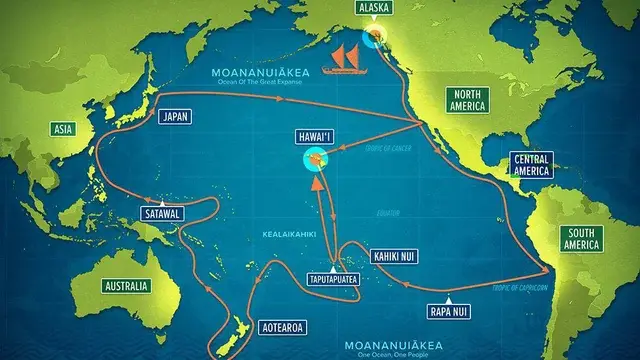
The current voyage is named Moananuiakea (Voyage for Earth) and was announced in 2023, as a four-year voyage throughout the Pacific (The Maui News, 2023). The voyage was planned to cover 43,000 nautical miles and 36 countries. Hokule’a and her safety escort sister canoe Hikianalia was shipped to Alaska in June 2023 to commence the voyage, and it is set to conclude in Tahiti in 2027. The main goal of the voyage: to ignite a movement of 10 million “planetary navigators” by developing young leaders and encouraging communities to take part in navigating Mother Earth towards a healthy and thriving future.
The ancient art of Polynesian wayfinding was on the verge of extinction. The revival of the Hawaiian culture was the catapult needed to save this cultural knowledge. We are now in the renaissance of sustainability and eco-friendly messaging. The time to take action is NOW. Our Mother Earth cannot wait, and Hokule’a and her hundreds of crew members are traveling the world to spread this message to care for mother earth and to also care for one another. Since my early connections to Hokule’a, I have pledged to do my part to care for mother earth – in growing the food that I am able to, finding ways of recycling, and living as sustainably as I’m able.

“The voyage is about sailing on the core set of values we believe in. The sail plan of humanity is off course. But there is a movement of kindness and compassion that is happening around the work in response to the damage to our Earth. Hokule’a is a needle sewing a lei of flowers around the world as an act of peace… and that is why we sail.”
Pwo Navigator, Captain and President of the Polynesian Voyaging Society
Nainoa Thompson. (Malama Honua, 2017)
References
Allen, J. (2017). Malama Honua. p 46, p 338
Anthony, N (2026). Crew Reflection: Na Inoa Kaulana. https://hokulea.com/crew-reflection-na-inoa-kaulana/
Chen, E (2023). She sails the seas without maps or compasses. https://web.archive.org/web/20230509214728/https://www.nationalgeographic.com/podcasts/overheard/article/she-sails-the-seas-without-maps-or-compasses
Low, S, (2013). Hawaiki Rising p. 19-24, p.53, p.122-131
Taotaha, M. (2013). Worldwide voyage protocol training. https://worldwidevoyage.hokulea.com/wwv-protocol-training-reflections-from-maui-tauotaha/
The Maui News. (2023) Hokule’a, HIkianalia to launch four-year journey around Pacific. Mauinews.com.



Comments