
UB Students Analyze Bad Bunny’s Very American Super Bowl Halftime Show
- Randy Laist
- May 13
- 9 min read

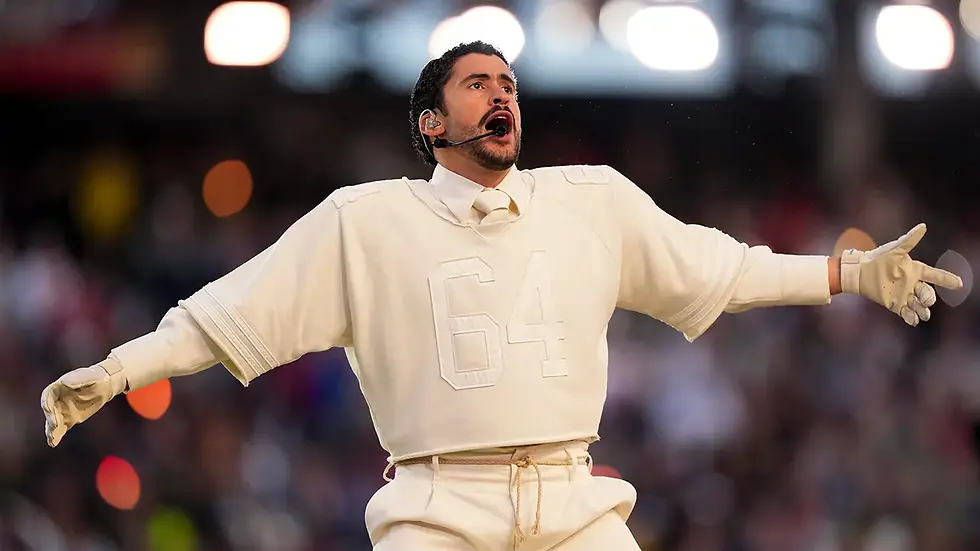
Right-wing critics attacked Bad Bunny’s Super Bowl Halftime Show as un-American, but the show emblematized many of the themes and values that characterize the American literary tradition.
When Puerto Rican recording artist Bad Bunny was announced as the headlining performer for the halftime show of Super Bowl LX, conservative commentators blasted the choice as un-American. Department of Homeland Security adviser Corey Lewandowski decried the NFL for picking “somebody who just seems to hate America so much to represent them at the halftime game." Speaker of the U.S. House of Representatives Mike Johnson, R-La., lamented that “There are so many eyes on the Super Bowl, a lot of young, impressionable children. And I think, in my view, you would have Lee Greenwood [the singer famous for the song “God Bless the USA”] or role models doing that.” Indeed, Turning Point USA produced a counterprogram to the NFL’s halftime show called "The All-American Halftime Show," which began with an electric guitar rendition of “The Star-Spangled Banner” followed by a performance of a song called “Real American” by Brantley Gilbert.
Of course, Puerto Rico is an American territory, so a Puerto Rican artist is technically American in a factual sense, but these conservative critics position Bad Bunny and his music as outside and indeed opposed to the cultural signifiers and values that they identify as “Real American.”
Fortunately, I work with a group of college students who are uniquely qualified to weigh in on the question of Bad Bunny’s contested Americanness. They are students of American Literature, some of whom have spent more than half a year reading deeply into the themes, tropes, and motifs that have characterized American culture and self-expression – in pre-Columbian times, in the days of the pilgrims and colonists, through the Revolution, Civil War, Reconstruction, World Wars, Cold War, and right up to today. Right up to Bad Bunny.
Having been so immersed in the deep-historical tradition, these students were able to consider whether the Apple Music’s Super Bowl LX Halftime show demonstrates any sense of consistency with this panoramic history, whether it “fits in” to the American tradition, and hence, to what extent it is “American” in a cultural-historical sense.
Bad Bunny and Cultural Hybridity
It should be recognized that Bad Bunny’s music and performance style is informed by traditions that originate outside of Noth America, in African, Caribbean, and South American contexts. The point of this line of inquiry is not to “assimilate” or “appropriate” Bad Bunny as a whitewashed gringo, nor to erase or paper over cultural difference. Quite the opposite, Bad Bunny’s performance at the half-time show expressed one of the most conspicuous and fraught themes in American literature and culture, the intermixing of cultural traditions into a new synthesis.
From the first Thanksgiving to Gloria Andalzua’s articulation of “mestiza consciousness,” representations of plurality and hybridity pervade American art and narrative as a prevailing preoccupation. Bad Bunny’s music itself, of course, blends its Puerto Rican reggaeton and Afro-Caribbean beats and tropes with elements of North American popular dance, electronic, and hip-hop music.
The lyrics of many of the songs Bad Bunny performs move freely between mainland and Puerto Rican settings. His list of girlfriends in the first song he performs in the show’s medley of Bad Bunny hits, “Titi me Pregunto,” mentions women from San Antonio and Miami as well as from locations in the Caribbean, and, while “Voy a Llevarte pa PR” describes Bad Bunny’s desire to take a woman from Miami to San Juan, the song “Neuva York” insists that “if you want to have fun with charm and grace, you just have to live a summer in New York [translated].” In these ways, Bad Bunny’s songs enact a project of weaving his regional culture into the fabric of North American history and culture.
In this respect, Bad Bunny’s music echoes the writing of Frederick Douglass, WEB DuBois, Claude McKay, Langston Hughes, and other African American writers who have used their artistry to create spaces of hybridity between African and American modes of being and self-expression, as well as that of writers from a range of historically marginalized perspectives – Sui Sin Far, Zitkala Sa, Abraham Cahan, Amy Tan, Sherman Alexie, Jhumpa Lahiri – who have used their artistry to expand the map of American identity.
The halftime show’s mixture of Puerto Rican and American emblems, its Puerto-Ricanization of Lady Gaga, and even its climactic internationalism, with dancers carrying South and Central American flags and marching in unison to Bad Bunny’s beat, emblematize the dream of creating solidarity out of diversity that has inspired American artists and thinkers from Hector St. John de Crevecouer to Herman Melville to Toni Morrison. E pluribus Unum. Very American.
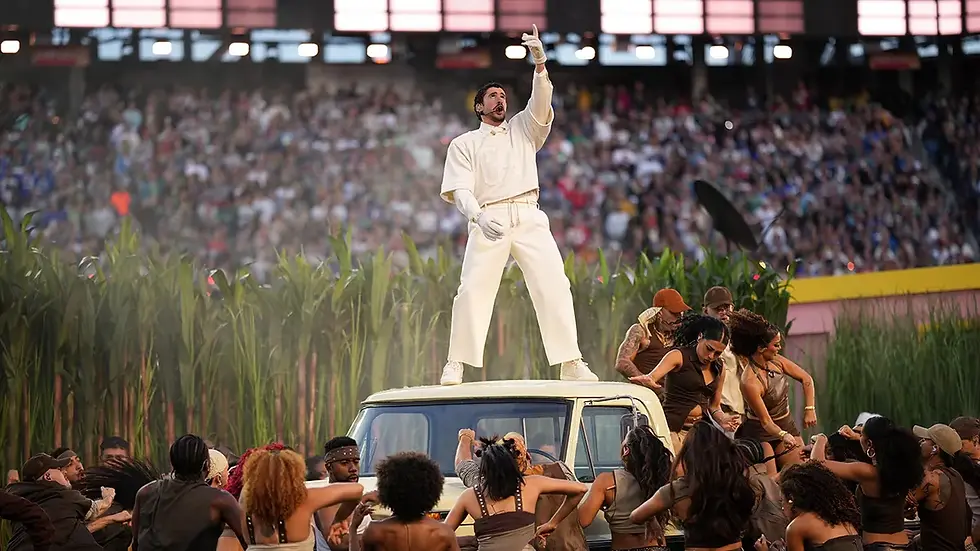
A Cane Field Grows in a Football Stadium: American Nature
The physical location of Bad Bunny’s performance provides a striking visual representation of a hybridized space. At the beginning of the show, we are introduced to the space of the show through an Apple logo that turns into a rainbow tunnel. The effect transports the viewer from wherever they are, the couch in front of their TV, presumably, across this interdimensional wormhole, and into the “new” world of the show in a manner that recapitulates the journeys of Columbus or Bradford across surreal seascapes to reach the Americas.
The first thing we see seems to be a natural setting: a field of sugarcane. But in a way that is uniquely pervasive in American literature, there is something unnatural about this nature. First, we see that it appears in a sepia wash with credits suggesting the opening scene of a pelicula. Then, of course, we see that this cane field has been surreally erected in the heart of Levi’s Stadium in Santa Clara and edited into the heart of the Super Bowl, the most high-tech mass-media event in the world. And of course, far from being a natural setting, a field of sugarcane is one of the signature achievements of early modern capitalism, a fact of enduring consequence to the histories and cultures of both Perto Rico and the North American mainland.
When European colonists and explorers came to the New World, they had to negotiate the knowledge that what they thought of as a wilderness was actually the living space for large populations of other people. As agriculture and industry transformed the landscape, the distinction between nature and technology became increasingly ambiguous. In our time of globalized communications and climate change, writers like Don DeLillo, William Gibson, and Octavia E. Butler have represented various depictions of this post-natural space.
The composition, contrast, and otherworldly continuity between these two registers provides a vivid visual impression of two worlds colliding and then interbreeding into a new kind of reality, an American hyperreality where nature and technology, personal identity and mass-spectacle, protest and performance collide into one another.
Bad Bunny, Mark Twain, and the Tradition of American Satire
One of the most striking features of the Bad Bunny halftime show is the white suit (or a few different versions of a white suit) that Bad Bunny wears throughout the routine. The white linen suit evokes a classic Puerto Rican style of dress, to be sure, but the student of American literature can’t help but think of another famous performer who became known for his white linen suit, the clown prince of American literature, Mark Twain.
It’s unlikely that Bad Bunny had Twain in mind when he picked his outfit, but the sartorial parallel opens up more substantive qualities that Twain and Bad Bunny have in common (in addition to their humorous stage-names). Bad Bunny is shown in the halftime show as a “man of the people,” casually interacting with domino players, street vendors, party-people, and other Puerto Rican types as he sings his way through the set. Mark Twain was also well-known and beloved as a flaneur, a raconteur, nimbly conversing with everyone he encountered regardless of their social rank.
This democratic sensibility is an essential component of both artists’ personae, and, at least in Twain’s case, it is one of the reasons he has been celebrated as a uniquely American writer. In the same way that Bad Bunny’s use of Puerto Rican Spanish in his music showcases the language of his region, Twain’s breakthrough as a writer was giving voice to the regional dialects that he grew up listening to.
Twain and Bad Bunny are both humorists, performers, and wordsmiths, but they also share a subversive streak that they smuggle into their crowd-pleasing antics. Twain was able to achieve celebrity status as a beloved icon of America, even as his humor frequently contained scathing indictments of the hypocrisy of white America. Bad Bunny manages a similar balancing act, becoming a fabulously successful recording artist who is invited to the Super Bowl, and then using this forum to stage a glittery spectacle that simultaneously enacts a political critique.
While Twain used his celebrity status to express unpopular anti-racist, anti-imperialist, and internationalist convictions, Bad Bunny uses his platform to express defiant Hispanophilia in a time of ICE raids and systematized violence against people of color. Underneath the glamorous spectacle, Bad Bunny’s show enacts a defiant suggestion that people of color playing professional football share cultural-semantic space with people of color laboring in the sugarcane fields, punishing their bodies for the delectation of white consumers. As in one of Twain’s gags, the scathingness of the critique is almost entirely camouflaged by the charisma with which it is articulated. More than just the white suit, Bad Bunny is carrying on Twain’s legacy of using his wit and talent to combat ignorance and injustice.
A Party with a Purpose: Bad Bunny and The Great Gatsby
Bad Bunny’s suit might also remind us of one of the most iconic characters from the American Literature curriculum, the title character of F. Scott Fitzgerald’s The Great Gatsby. In fact, the whole spectacle surrounding Bad Bunny, the rowdy crowds of party people and the atmosphere of drunken sensuality and intoxicated affluence (while the sets depict working-class neighborhoods, the songs describe a life of driving Audis, snorting cocaine, flying to the Maldives, etc.) reflects the tradition of hedonistic abandon that Fitzgerald depicted in his famous novel.
Like the white suit, however, this somewhat superficial similarity between Bad Bunny’s show and Gatsby’s parties reveals a more meaningful structural similarity. In Fitzgerald’s novel, Gatsby’s parties are thrown for a very specific purpose. Rather than being spontaneous outbursts of human exuberance, they are planned and staged by Gatsby in order to seduce his old love, Daisy, who lives across the bay from Gatsby’s party-house, where she endures a troubled marriage with her racist husband Tom.
One way of reading the novel is to see Daisy as America and Gatsby and Tom as two lovers competing fer her affection. Gatsby, in his romantic idealization and beautiful naivete, is the America of open possibilities, of utopian dreams of perfection, of self-becoming, of transcendent aspirations toward an “orgastic future.” Tom is America's nightmare boyfriend, a figure of fascism, violence, patriarchy, and careless power. Gatsby’s parties are elaborate displays intended to woo Daisy away from her fascist jerk husband and toward the more luminous possibilities represented by Gatsby.
A similar dynamic is afoot in Bad Bunny’s Super Bowl halftime show. If Bad Bunny can throw a big enough party, with enough attractive people, enough music, sex, booze and celebrity, then maybe he can seduce America away from the fascist husband that she wound up married to. Sadly, as readers of the novel know, Gatsby’s hope is doomed from the start. Daisy has always already married Tom, and she even conspires with Tom, at least implicitly, to murder Gatsby and extinguish his aspirational American dream. But Bad Bunny continues the party, continues reaching out toward the green light of the on-air signal, exerting himself heroically to make us fall in love with his vision of America as a musical, energetic mixing-together of people and languages and cultures.
The Anti-Fascist Theme in American Literature
It is undeniably the case that there is a certain nativist subculture in America – there seems to always have been – that espouses white supremacy, Christian nationalism, and xenophobic insularity. That strain of American discourse was on display in the right-wing denunciations of Bad Bunny’s alleged Un-Americanness.
But that voice, as loud as it sometimes seems in political journalism, streaming media, and certain subcultural enclaves, is almost entirely drowned out in the rich cacophony of American voices that have contributed to the country’s literary heritage. While his critics mouthed their objections, Bad Bunny’s halftime show managed to become the most-watched halftime show in NFL history, earning a place within the resolutely pluralistic and ant-fascist tradition of American literary culture.
Thanks to ENGL 208 students who contributed perspectives to this article: Yaser Abdulaziz S. Alraddadi, Steeve Brazelais, Joaquin Brasher, Negel Brown, Glendon Chancey V, Benjamin Collins, Genna D’Amatto, Briseida Escobar, Francesca Faura, Gabrielle Lamb, Angelina Ledesma, Sienna Lucas, Emily Ortiz, Imani Phillip, Alison Portillo, Ava Robalino, Christofer Rodriguez-Fico, Rosabella Silano, Hailey Tirado, and Emily Turner. Special thanks to Francesca Faura for her critical perspicacity and editorial assistance.

Works Cited
“Bad Bunny’s Apple Music Super Bowl Halftime Show.” YouTube.
Coleman, Ryan. “Trump administration threatens to send ICE to Super Bowl during Bad Bunny's halftime show.” Entertainment Weekly.
Fitzgerald, F. Scott. “The Great Gatsby.” Charles Scribner’s Sons. 1925.
Mediaite. “Mike Johnson Calls Bad Bunny Halftime Show a ‘Terrible Decision’ for NFL — Says Children Should Listen to 82-Year-Old Lee Greenwood Instead.” Y! Entertainment.
Segarra, Edward. “Here's how many people really watched Bad Bunny's halftime show.” USA Today.



Comments